
About Us
O'Kelly Chapel's History

James O’Kelly, a pivotal figure in early American religion, significantly influenced the establishment of O’Kelly Chapel and the broader Christian Church in Durham, North Carolina. Born around 1735 in Virginia, O’Kelly commenced his ministry as a Methodist preacher during the Great Awakening, a period marked by profound religious fervor. He was a compelling orator, traversing the Southern states to disseminate his message and forge deep, personal connections with congregants.
O’Kelly championed congregational autonomy in the Methodist church, asserting that local communities, not bishops, should choose spiritual leaders, directly challenging Bishop Francis Asbury’s hierarchical approach.
From 1770 through 1804, O’Kelly served as a circuit-riding minister, ministering to O’Kelly Chapel, Martha’s Chapel, and Damascus Christian Church. However, an irreconcilable disagreement culminated at a significant Methodist meeting in 1792. O’Kelly, along with numerous ministers and their congregations, chose to secede. This event, known as the “O’Kelly Schism,” marked a pivotal moment for religious freedom in America.
O’Kelly and his followers, initially “Republican Methodist,” soon became the “Christian Church,” emphasizing fundamental principles and unity. O’Kelly also advocated for anti-slavery within the Methodist church. These ideals shaped a unique American religious movement focused on independence and unity.
While the precise founding date is not definitively known, O’Kelly Chapel emerged in the late 1700s or early 1800s, a direct result of James O’Kelly’s influence and the burgeoning Christian Church in North Carolina. It swiftly became a vital hub for the new denomination within the Durham vicinity.
O’Kelly Chapel transcended its function as a mere edifice; it served as a tangible embodiment of James O’Kelly’s vision. It symbolized the empowerment of local churches and the paramount importance of Christian unity. The chapel stands as an enduring testament to O’Kelly’s unwavering dedication to religious freedom and universal liberty. It is a historically significant site, representing a key juncture in American religious history and the enduring impact of a man who steadfastly adhered to his convictions.
The current chapel, constructed in 1910, is the fourth building on this site.
Further information can be found by consulting the cemetery census for O’Kelly Chapel here.
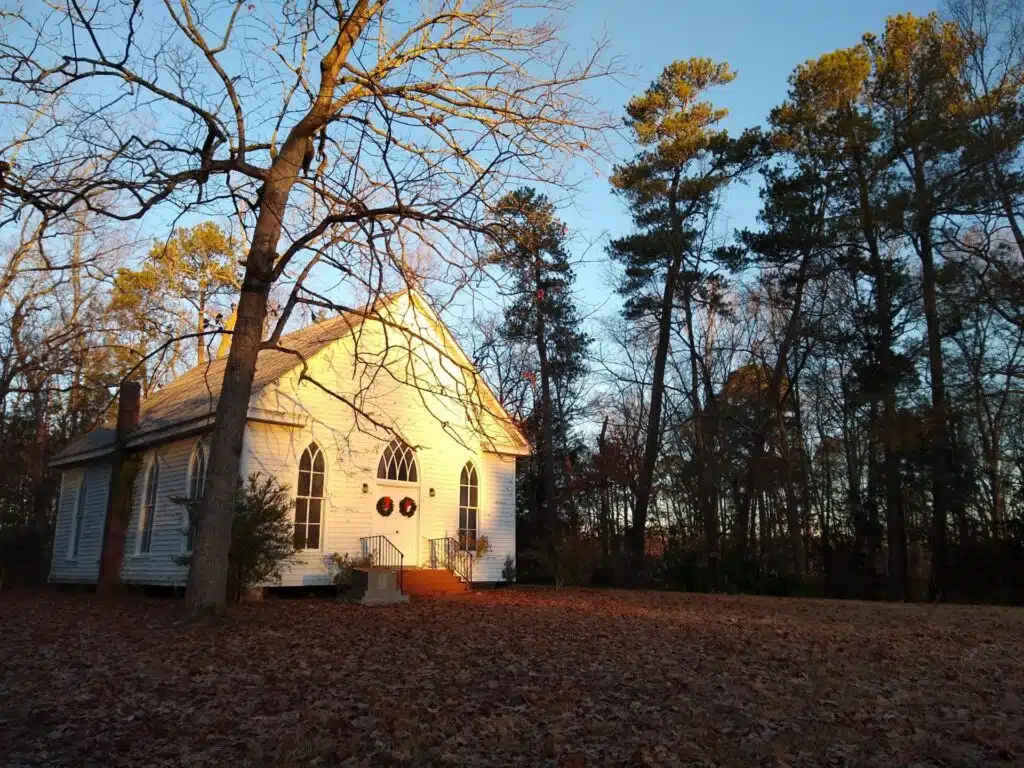
A Labor of Love
In 2018, the Southern Conference of the United Church Christ proposed to Scott and Marsha Pearce the sale of O’Kelly Chapel for integration into their established and successful business. At that time, the Pearces were proprietors of For Garden’s Sake, a lawn, landscape, and garden center business situated to the south of O’Kelly Chapel.
Inspired by this prospect, a vision emerged to integrate the church into their existing business. Discussions were held regarding relocating the church to For Garden’s Sake premises; however, following consultations with landscape architects, septic engineers, and county officials, the decision was made for the church to remain in its original location, continuing its role as a symbol of hope for the community.
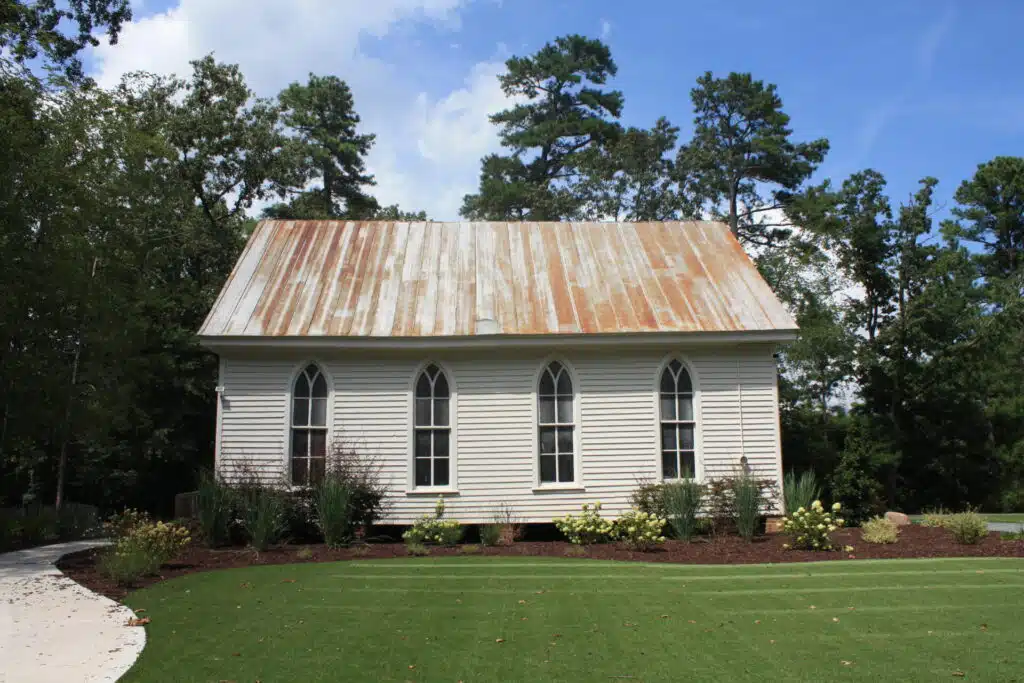
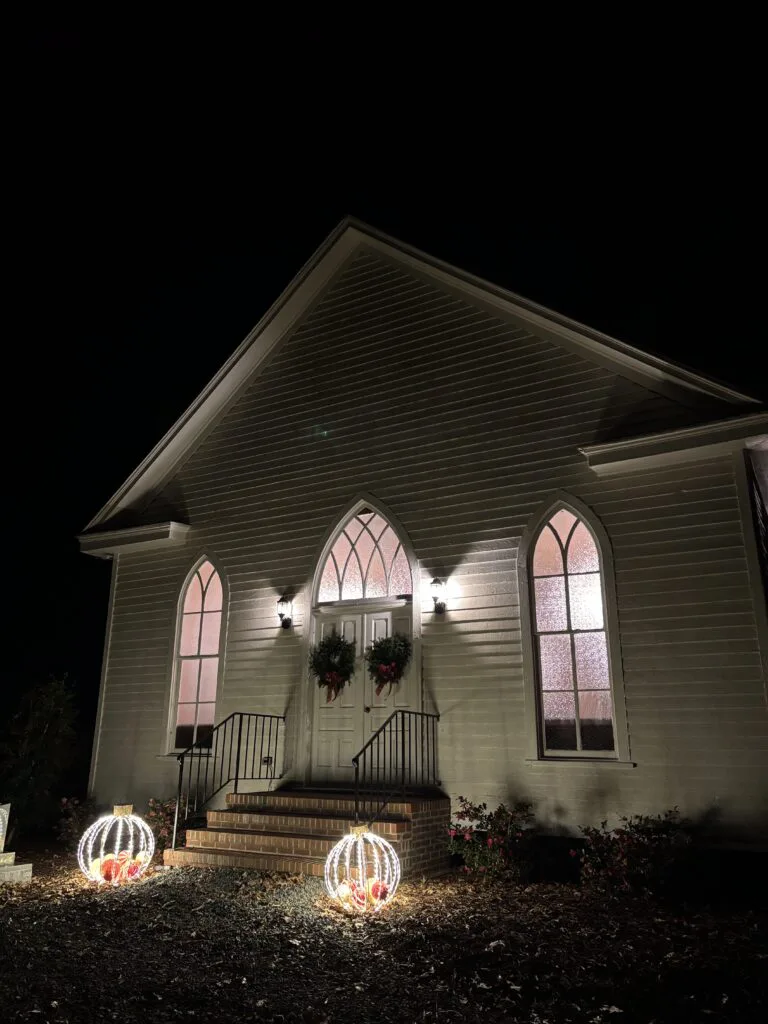
The renovation began with the challenging task of removing the dilapidated brick chimney. Its disrepair was causing leaks to the interior wall and exterior rot. After the chimney was dismantled, the damaged wood on both the interior and exterior was replaced.
Originally, the chapel’s corners rested on boulders, serving as true cornerstones. These were extracted after the church was elevated eight inches. Benjamin Hale Builders constructed new pillars along both sides and down the center of the building, after removing the middle floorboards. These pillars were then brick-wrapped to complement the church’s entrance staircase. The original railings were taken down, repaired, and reinstalled on the new entryway.
In 2021, on Thanksgiving night, the building was illuminated for the first time after newly installed electricity, air conditioning, and heating was complete. This brought a welcome light to a previously dark intersection, much to the community’s delight.
O’Kelly Chapel’s extensive renovation inside as well as outside was completed in the fall of 2024. It is now ready to host a diverse array of events. This successful revitalization, which included meticulous efforts to secure county and state permits for modern restroom facilities, aligns perfectly with For Garden’s Sake’s long-term objectives. The chapel is now a fully operational cornerstone for community engagement and private gatherings, all of which complement the company’s core mission and vision for the future.